
Hamilton County Wanted Listings
The Hamilton County Sheriff's Office has no standalone Most Wanted page. Go regional instead. The best public option is the Greater Cincinnati/Northern Kentucky Crime Stoppers Wanted Suspects listing. It holds roughly 152 entries across eight pages. That count shifts as listings come and go. Entries from HCSO and the Cincinnati Police Department appear there alongside items from other area agencies, so check the named agency before assuming a Hamilton County connection.
Treat it as a tip tool, not a custody feed. You can filter or sort by agency, surname, recent entries, and wanted date. Use the agency and date fields as leads worth following through official channels rather than as a replacement for an HCSO warrant check or a court inquiry.
The Crime Stoppers wanted-list interface appears here as a source-page view rather than a reproduced poster.
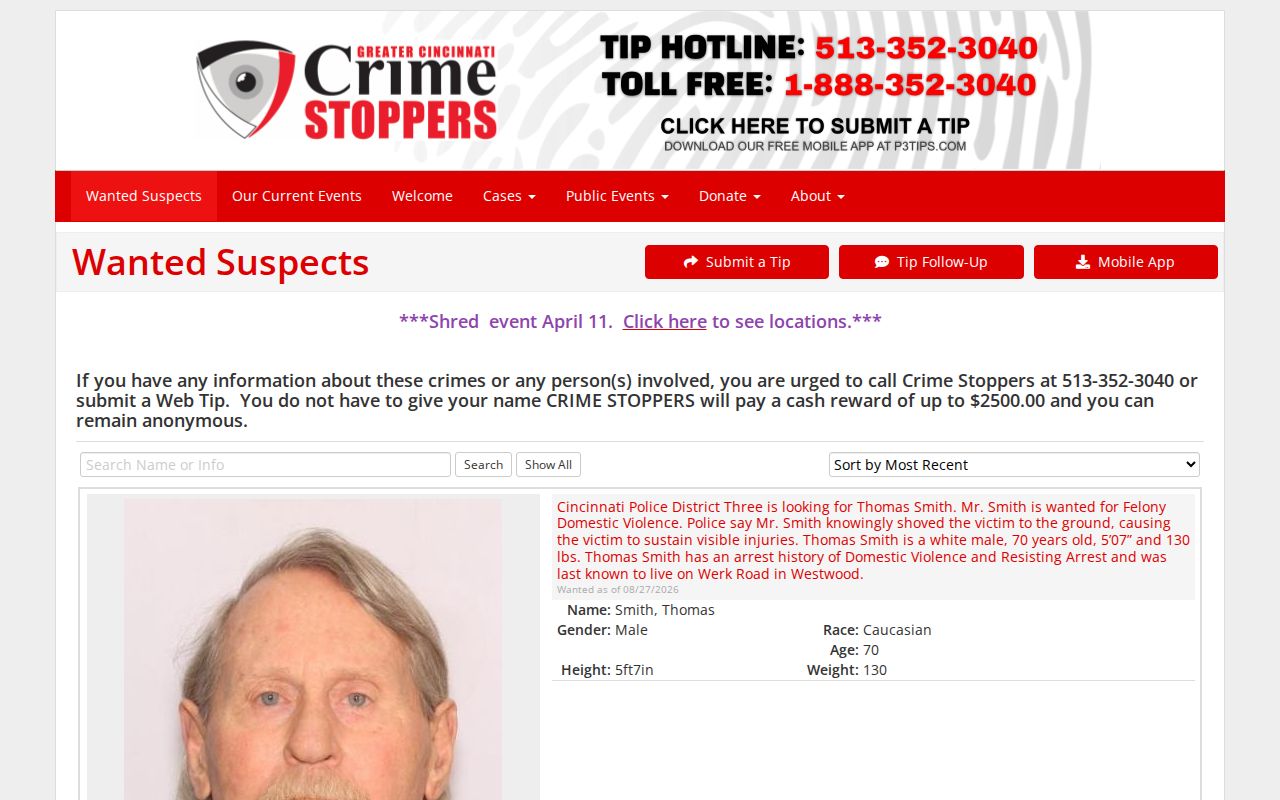
Treat the agency and date fields as leads. They can guide a tip or point you toward an official follow-up, but they do not replace a warrant check with the HCSO or the courts.
Hamilton County Wanted Record Fields
A Crime Stoppers entry can carry more than a bare name. Match the agency, the identifying details, and the wanted date before you share anything. Photos, descriptions, and charges can be incomplete or dated. Some belong to regional agencies rather than HCSO. The table below describes the fields the regional interface can display. Not every result fills in every field.
| Field | What it can show |
|---|---|
| Agency | The department associated with the entry, which may be HCSO, Cincinnati Police, or another regional agency. |
| Wanted date and status | When the listing was posted and its displayed status, both of which can change. |
| Name and descriptors | The listed name and physical identifiers used to help distinguish people with similar names. |
| Last known area | A location clue supplied for the entry, not an instruction to search for or contact a person. |
| Alleged charges or history | The reported basis for the listing. Charges can be amended, dismissed, or resolved differently in court. |
| Photograph | An image displayed by Crime Stoppers when available. It remains on the source page and is not republished here. |
Note: A listed charge is a starting point for official verification, not a final account of what a court later decided.
Using Hamilton County Wanted Listings
The safe role of a regional list is narrow. Observe what is already public, then route a tip to the right official channel. Never try to identify, follow, confront, or locate a listed person yourself. If there is an emergency or immediate threat, call 911. Should a listed person later enter HCSO custody, the current custody record becomes the place to check. A roster result on its own still will not confirm a warrant.
- Open the regional wanted-list page and select the listed agency or use the surname, date, and recency controls to narrow a result.
- Read the agency, displayed status, and descriptors without attempting personal contact or independent tracking.
- For a non-emergency public-safety lead, send the information through HCSO or Crime Stoppers rather than posting it publicly.
- For a question about a specific Hamilton County case, use the warrant office, court, or an attorney to verify what the entry means.
The list is regional and always changing. An entry that looks like an HCSO item may vanish or change before anyone acts on your tip. When you contact the receiving office, pass along the agency, the name, the page details, and any safe firsthand observation. That helps far more than repeating a claim you cannot back up.
Hamilton County Tip Contacts
Hamilton County offers two distinct public-safety paths. HCSO takes official tips through its online form plus a call or text line. Crime Stoppers, meanwhile, runs the regional wanted-list channel, accepts anonymous web tips and calls, and advertises a possible reward. That reward policy belongs to Crime Stoppers alone, not to every HCSO communication. Neither path provides legal advice or immediate police response.
Safety first. Do not approach or warn a wanted person. If it is an emergency, call 911 right away. For anything less urgent, pass what you know through an official tip channel.
HCSO official tip route
Submit a Tip
Call or text: 513-586-5533
Emergency: 911
Greater Cincinnati/Northern Kentucky Crime Stoppers
Anonymous web tip
Phone: 513-352-3040
Advertised reward: up to $2,500
The HCSO contact directory lists the official county channels shown above. A reward offer changes nothing about reporting only what you know firsthand.
Hamilton County Warrant Layers
Three different tools sit side by side here. The regional wanted list is for tips. HCSO's Fugitive Warrant Unit handles enforcement, and the Child Support Violations search covers one narrow slice of warrant data. According to HCSO Court Services, the Fugitive Warrant Unit works with grand-jury indictments, capias, and Common Pleas warrants, along with SOFAST and U.S. Marshals Service operations. The Child Support search updates on weekdays and holidays, its own notice says, and every warrant it returns still needs confirmation. It is not an all-warrants search.
The HCSO Court Services page gives the official account of the Fugitive Warrant Unit's role.
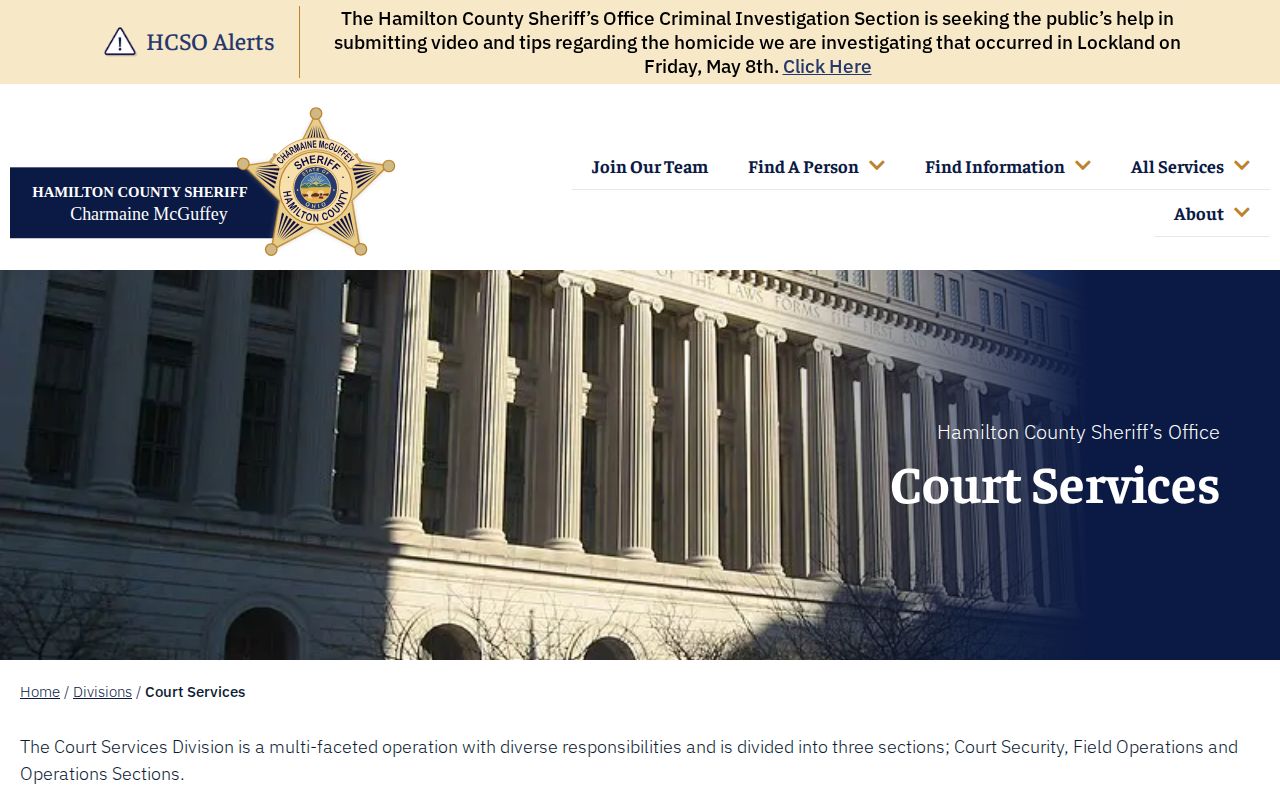
The Court Services view helps separate an official warrant function from a regional tip listing or a custody roster. Each layer has its own scope. Someone can be missing from the Crime Stoppers list while an official court or warrant question still waits on an answer. A current roster entry shows custody status only. It says nothing about why a warrant was issued or where the case stands. Keeping the layers distinct keeps a public-safety list from being mistaken for a complete legal record.
| Layer | Purpose and limit |
|---|---|
| Crime Stoppers wanted list | Regional public tip resource with dynamic listings. It is not a complete HCSO warrant file. |
| Fugitive Warrant Unit | Official HCSO Court Services function for specified felony and court warrant work. |
| Child Support Violations search | Narrow official database, with its own update claim and confirmation warning. |
| Court record | Useful for a known case, but remote publication limits mean it cannot serve as a complete warrant check. |
Check Hamilton County Warrants
Want to know if a warrant has your name on it? Call the office that can actually confirm it. HCSO takes Felony Warrant questions at 513-946-5350. Court Services sits at 513-946-5320. Aggregators, wanted-list filters, and inmate rosters are the wrong tools for a personal warrant check. If the question ties to a court case you already know about, the Hamilton County Clerk records search can help you pin down the case number and docket.
One local quirk matters here. Municipal Rule 9 bars the routine online publication of criminal warrants, police referral records, and certain bond and search-warrant material. So a blank result online tells you very little. Absence from a website is never evidence that a warrant does not exist.
- Gather the exact name and any case number without relying on a name-only match.
- Contact Felony Warrants or Court Services for an official Hamilton County question, or speak with an attorney when legal advice is needed.
- Use the Clerk's record route to follow a known case, while recognizing that some warrant materials are not published for ordinary remote access.
- Address a confirmed matter through the court, official warrant office, or counsel. Do not attempt to avoid or work around a warrant.
The narrow Child Support Violations search belongs only in its stated subject area.
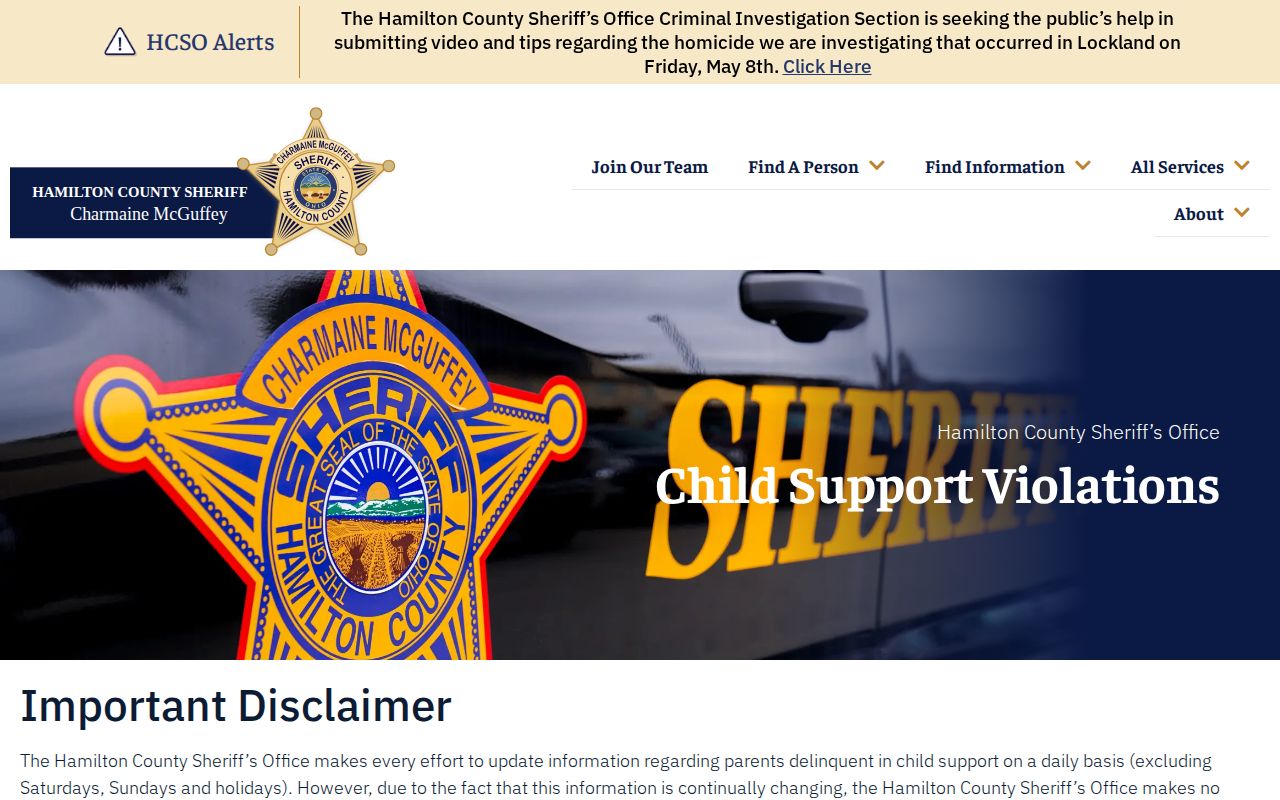
Expect the official screen and its disclaimer to point you right back to that rule. Verification belongs with the official process, full stop. A court search works best once a case number is in hand, though even then it is not a complete answer, since the Clerk says remote access is not provided for every case or document. Name searches bring their own problem. Common surnames can return ambiguous matches, so compare a date of birth or case number before calling any office about a record.
Hamilton County Court and Custody Records
Warrants and bookings overlap in practice. The records serve different jobs, though. The HCSO inmate roster shows who sits in county custody right now. Court records live elsewhere. Felony dockets sit with the Common Pleas Clerk, while Municipal Court handles misdemeanor and municipal matters. Court activity often continues long after release. A person can walk out of the Justice Center with the case still pending. For a known case, search the Clerk records by case number whenever possible. Municipal Rule 9 keeps certain criminal-warrant, police-referral, bond, and search-warrant material off ordinary online publication. So a blank remote docket proves nothing. A specific Clerk request is the more reliable route. Question: Does a wanted-list result prove someone is in jail? Answer: No. A wanted list is not a custody feed. The HCSO roster covers current county custody; the warrant unit or court answers warrant questions.
Hamilton County Release-Payment Warning
Here is a scam worth knowing. Hamilton County Municipal Court warns that impostors have posed as county personnel and demanded electronic payment for electronic monitoring. The county never requires payment before release, the court says. Hang up on any unexpected payment demand. Verify through a phone number or web address pulled from the official court or sheriff source, never from the caller. Families scrambling to confirm a booking, bond, or warrant are exactly who these callers prey on. Keep your sources straight when several agencies are involved. Crime Stoppers runs a regional tip listing. HCSO Court Services handles particular county warrant functions. The Child Support Violations page covers only its stated subject. The current-custody roster is the separate source for someone actually listed at the Justice Center. Before making any call, identify the agency, the record type, and the date. That habit cuts down on repeating outdated listings and mistaking a regional entry for a court result.